Cancellation of a contract without justified reasons constitutes a serious breach, causing significant damage to the non-breaching party. A proper understanding of legal provisions on contracts, permissible legal basis for contract cancellation, and the legal consequences of unlawful cancellation is essential to safeguard legitimate rights and interests.
I. Current situation regarding contract cancellation without justified reasons
In a developing business market, contracts serve as the fundamental legal basis for relevant parties to conduct business transactions and agreements.

However, cancelling contracts without justified reasons remains common, negatively impacting operations and the reputation of enterprises. Typical situations of such cancellation include:
- Changes in business strategy: Enterprises change their business strategies and no longer need to execute signed contracts.
- Cooperation with high advantageous partners: Enterprises receive more attractive offers from other partners and decide to cancel holding contracts.
- Financial difficulties: Enterprises face financial hardship and are unable to fulfill their contractual obligations.
II. What is contract cancellation without justified reasons?
1. Definition
Cancellation of a contract without justified reasons refers to an act of one party unilaterally cancelling the contract in contravention of legal regulations and the parties’ agreement. Specifically, it means contract cancellation fails under any of the lawful grounds stipulated in Clause 1, Article 423 of the Civil Code 2015, including:
- One party breaches the contract under a condition for cancellation agreed upon by the parties;
- One party commits a material breach of contractual obligations, thereby affecting the engagement purpose of the contract for the non-breaching party;
- Other cases as provided by law.
Such conduct may give rise to liability for damages to the non-breaching party in accordance with the law.
2. Common situations of contract cancellation
In practice, common cases of contract cancellation include:
- Failure to fulfill payment obligations: The buyer fails to make payment on time or in full as agreed.
- Failure to deliver goods or delivery of unqualified goods: The seller fails to deliver goods on schedule, in the agreed quantity or type, or the goods do not meet the quality standards committed.
- Breach of confidentiality: One party discloses confidential information to a third party.
- Changes in internal policies or regulations: An enterprise changes its internal rules, making it impossible to continuously execute the contract.
III. Legal provisions contract cancellation without justified reasons
1. Impacts of contract cancellation without justified reasons
Such unlawful cancellation causes serious consequences:
- Violation of law: Breaches of contractual legal provisions disrupt legal order and sane business operations.
- Damages to the non-breaching party: Breaches cause property loss, opportunity costs, and commercial reputation damage.
- Increased dispute resolution costs: It leads to prolonged litigation, wasting time and resources for both parties.
- Impacts on business relationships: Such matters undermine parties’ trust and hinder future cooperation.
2. Relevant legal provisions
Vietnamese law clearly regulates contract cancellation to protect parties’ rights and prevent arbitrary, harmful acts. Accordingly, main provisions include:
- Grounds (Civil Code 2015): Cancellation is only permitted where justified grounds exist, such as a material breach by the other party or objective events rendering execution impossible (Articles 422–426).
- Legal consequences (Civil Code 2015): Upon cancellation, parties are released from further obligations but must return what they have received. The breaching party must compensate for any damages caused (Article 427).
- Unilateral termination (Civil Code 2015): It differs from cancellation. Accordingly, a party has the right to unilaterally terminate a contract as agreed or by law but must comply with notice and compensation obligations, if applicable (Article 428).
- Specific rules for sale and purchase contracts of goods (Commercial Law 2005): Cancellation must follow Articles 312–313 regarding parties’ rights and obligations.
3. Conditions for contract cancellation
According to Article 423 of the Civil Code 2015, cancellation may only occur when:
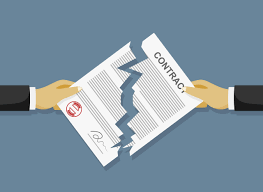
- There is a material breach of contractual obligations;
- There is a clear agreement for cancellation;
- The law allows cases of cancellation (e.g., the contract is void under Article 407).
4. Sanctions for unlawful cancellation
Unlawfully cancelling a contract constitutes a breach and will be handled as follows:
- Damages: The breaching party must compensate the non-breaching party for actual losses, including direct costs, lost profits, and legal fees (Articles 427, 584 of Civil Code 2015).
- Contractual fines: If the contract states fines for breach, the breaching party must also pay fines as agreed (Article 418 of Civil Code 2015).
- Court orders: If the non-breaching party objects to the cancellation, it may initiate proceedings to compel execution.
IV. Questions about contract cancellation without justified reasons
1. How is compensation calculated when cancelling a contract without justified reasons?
Compensation is determined based on Articles 427 and 585 of the Civil Code 2015, applying the following principles:
- Full, prompt and actual compensation (Clause 1 of Article 585 and Clause 3 of Article 427):
- Direct losses: Irrecoverable expenses incurred for contract execution of the non-breaching party.
- Indirect losses: Expected profits should have been enjoyed if the contract had executed as agreed.
- Mitigation costs: Reasonable costs to reduce losses.
- Restitution (Clause 2, Article 427):
- The parties must return to each other all that they have received, after deducting reasonable expenses incurred during the contract execution. Restitution in kind is prioritized; if not possible, the value shall be refunded in monetary terms.
- Consideration of fault and financial capacity (Clauses 2, 4, and 5 of Article 585):
- The party causing the damage may have the compensation amount reduced if it results from unintentional fault or is disproportionately large compared to their financial capacity (Clause 2).
- The injured party shall not be compensated for the portion of damage caused by their own fault (Clause 4), or if they fail to take necessary and reasonable measures to prevent or mitigate the damage (Clause 5).
- Agreement or adjustment of compensation (Clauses 1 and 3 of Article 585): The parties may agree on the amount, form (monetary payment, restitution in kind, or performance of work), and method of compensation. If the agreed compensation amount becomes inconsistent with actual circumstances, either party has the right to request the Court or another competent authority to make appropriate adjustments.
2. What remedies apply in international commercial contracts?
In international commercial contracts, when a party cancels a contract without justified reasons, the applicable remedies are governed by Articles 300 to 305 of the Commercial Law 2005. These remedies include:
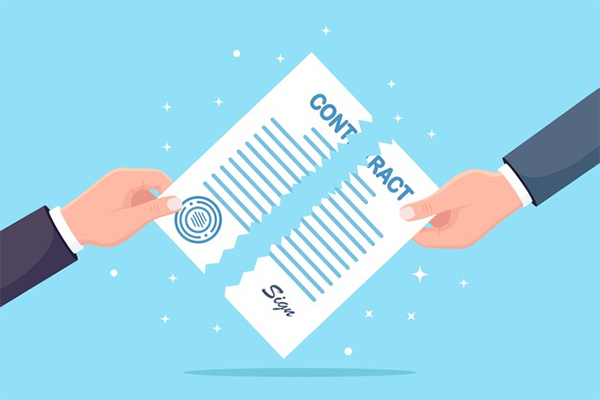
Sanctions for breach (Articles 300 and 301):
- The non-breaching party has the right to require the breaching party to pay a fine if the contract contains a fine clause.
- The fine amount shall be as agreed by the parties in the contract but must not exceed 8% of the value of the contractual obligation that has been breached.
- Such provision does not apply in cases where liability is exempted under Article 294 of the Commercial Law 2005.
Compensation for damages (Articles 302, 303, 304, and 305):
- Principle of compensation (Article 302): Compensation shall cover losses, including actual and direct losses and the value of direct profits that the non-breaching party would have gained if the contract had been properly executed.
- Grounds for compensation (Article 303): Liability for compensation arises when all three of the following elements exist:
+ A contractual breach has occurred;
+ Actual damage has been sustained;
+ The contractual breach is the direct cause of the damage. - Burden of proof (Article 304): The party claiming compensation must prove the occurrence of the loss, the extent of the loss, and the direct profits.
- Duty to mitigate (Article 305): The claimant must take reasonable measures to mitigate the loss. If failure, the breaching party has the right to request a reduction in the compensation amount corresponding to the losses that could have been mitigated.
These remedies are regulated to protect the lawful rights and interests of parties in international commercial contracts and to encourage proper execution of contractual commitments.
3. Contracts are vulnerable to termination without justified reasons
Common vulnerable contracts include:
- Sale of goods contracts (especially large-value or long-term);
- Construction contracts (due to extended duration and risk factors);
- Business cooperation contracts (due to differing interests);
- Agency contracts (as principals may seek better partners).
4. Can I claim compensation for profits that would have been enjoyed if the contract was terminated without just cause?
Under Article 302 of the Commercial Law 2005, the non-breaching party may claim both actual losses and the value of direct profits that would have been enjoyed, provided they can prove such profits under a certain legal basis and calculate them.
V. Why legal counsel is essential in cases of contract termination without justified reasons
Consulting experienced contract lawyers is crucial, as they can:
- Assess the legality of the termination and provide accurate advice on rights and obligations;
- Guide evidence collection to substantiate damages;
- Represent clients in mediation and negotiation;
- Prepare claims and represent clients before courts or arbitral tribunals.
NPLaw offers professional legal consultancy services on contract disputes, helping clients:
- Receive comprehensive legal advice on contract, commercial, and damage compensation issues;
- Obtain thorough support in evidence gathering and legal drafting;
- Be represented to protect their lawful rights before competent authorities or in court.
Contact NPLaw today for professional legal consultation and protection against damages arising from unlawful contract termination.